Photovoltaic PV MODULE FOR PRODUCING ELECTRICITY RENEWABLE AND ALTERNATIVE ENERGY SOURCES
PHOTOVOLTAIC MODULES
 
Last Update
01-05-2012
HOW DOES PHOTOVOLTAIC WORKS?
 
 
PHOTOVOLTAIC SYSTEM
 
frecciaWHAT YOU NEED TO GET A QUOTE HOW TO HAVE PREFERRED FUNDING AND INSTALL THE SYSTEM
HOW MUCH A PHOTOVOLTAIC PLANT COSTS?
frecciaHOW MUCH PHOTOVOLTAIC COSTS
 
 
THE NEW FRONTIER FOR PHOTOVOLTAIC
PHOTOVOLTAIC
frecciaSOLAR PANELS: FURTHER INFORMATION AND ADVICE
 
WHAT ARE THE RENEWABLE ENERGY?
freccinaALTERNATIVE ENERGY
 
THE FAKE PROBLEMS ON PHOTOVOLTAIC
freccinaTHE PROBLEM OF DISPOSAL OF SOLAR PANELS
 
frecciaTHE PROBLEM REGARDING ENERGY TO PRODUCE THE PANELS
QUESTIONS AND ANSWERS ON ENERGY SAVING
frecciaENERGY SAVING: QUESTIONS AND ANSWERS
OTHER RENEWABLE ENERGY
frecciaHYDROPOWER
frecciaGEOTHERMAL ENERGY
frecciaENERGY BY BIOGAS OR BIOMASS
frecciaWIND ENERGY
frecciaSOLAR THERMAL
frecciaWAVE AND TIDAL ENERGY
frecciaMOLECOLAR DISSOCIATION ENERGY
frecciaNUCLEAR ENERGY
ITALIAN LAWS AND DECREES
 

Home > The photovoltaic panels: TYPE OF INTEGRATION OF FOTOVOLTAIC PLANT: OVER THE ROOF, OVER THE GROUND and on the WATER!

 
Solar photovoltaics (PVs) are arrays of cells containing a material that converts solar radiation into direct current electricity. Materials presently used for photovoltaics include amorphous silicon, polycrystalline silicon, microcrystalline silicon, cadmium telluride, and copper indium selenide/sulfide.[1] Due to the growing demand for renewable energy sources, the manufacture of solar cells and photovoltaic arrays has advanced dramatically in recent years.
 

photovoltaic roof

solar pv panels

IN BUILDING

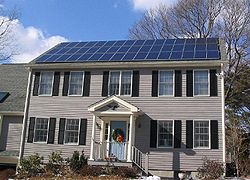
Photovoltaic solar panels on a house roof.
Building-integrated photovoltaics (BIPV) are increasingly incorporated into new domestic and industrial buildings as a principal or ancillary source of electrical power,[41] and are one of the fastest growing segments of the photovoltaic industry.[42] Typically, an array is incorporated into the roof or walls of a building, and roof tiles with integrated PV cells can now be purchased. Arrays can also be retrofitted into existing buildings; in this case they are usually fitted on top of the existing roof structure. Alternatively, an array can be located separately from the building but connected by cable to supply power for the building.
Where a building is at a considerable distance from the public electricity supply (or grid) - in remote or mountainous areas – PV may be the preferred possibility for generating electricity, or PV may be used together with wind, diesel generators and/or hydroelectric power. In such off-grid circumstances batteries are usually used to store the electric power.
In locations near the grid, however, feeding the grid using PV panels is more practical, and leads to optimum use of the investment in the photovoltaic system. This requires both regulatory and commercial preparation, including net-metering and feed-in agreements. To provide for possible power failure, some grid tied systems are set up to allow local use disconnected from the grid. Most photovoltaics are grid connected. In the event the grid fails, the local system must not feed the grid to prevent the possible creation of dangerous islanding.
The power output of photovoltaic systems for installation in buildings is usually described in kilowatt-peak units (kWp).

In transport

PV has traditionally been used for auxiliary power in space. PV is rarely used to provide motive power in transport applications, but is being used increasingly to provide auxiliary power in boats and cars. Recent advances in solar race cars, however, have produced cars that with little changes could be used for transportation.


Standalone devices


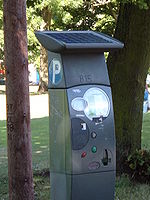
Solar parking meter.
Until a decade or so ago, PV was used frequently to power calculators and novelty devices. Improvements in integrated circuits and low power LCD displays make it possible to power such devices for several years between battery changes, making PV use less common. In contrast, solar powered remote fixed devices have seen increasing use recently in locations where significant connection cost makes grid power prohibitively expensive. Such applications include parking meters, emergency telephones, temporary traffic signs, and remote guard posts & signals.


solar panel photovoltaic ticket parking meter
 

Ricerca personalizzata


Rural electrification
Developing countries where many villages are often more than five kilometers away from grid power have begun using photovoltaics. In remote locations in India a rural lighting program has been providing solar powered LED lighting to replace kerosene lamps. The solar powered lamps were sold at about the cost of a few month's supply of kerosene. Cuba is working to provide solar power for areas that are off grid. These are areas where the social costs and benefits offer an excellent case for going solar though the lack of profitability could relegate such endeavors to humanitarian goals.
Solar roadways
Main article: Solar roadway
A 45 mi (72 km) section of roadway in Idaho is being used to test the possibility of installing solar panels into the road surface, as roads are generally unobstructed to the sun and represent about the percentage of land area needed to replace other energy sources with solar power.

Optimum Orientation of Solar Panels
For best performance, PV systems aim to maximize the time they face the sun. Solar trackers aim to achieve this by moving PV panels to follow the sun. The increase can be by as much as 20% in winter and by as much as 50% in summer. Static mounted systems can be optimized by analysis of the Sun path. Panels are often set to latitude tilt, an angle equal to the latitude, but performance can be improved by adjusting the angle for summer and winter.


Kyoto protocol
 
FINANZIAMENTI FOTOVOLTAICO MUTUO FOTOVOLTAICO

If you find this site interesting, please RATE IT on

Energyleague.com

 TOP100-SOLAR


Giesse Studio- P.Iva 02263650463
Copyright Giesse Studio - P&P Project 2006-2012