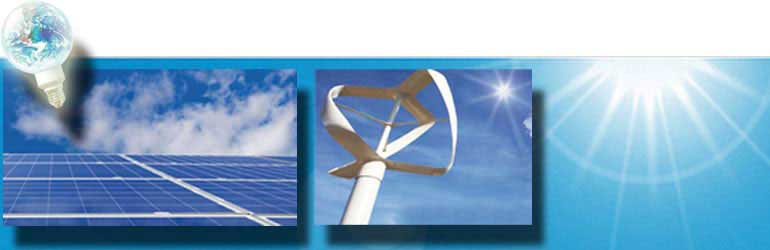
A PV module on the ISS.
A photovoltaic module or photovoltaic panel is a packaged
interconnected assembly of photovoltaic cells, also known
as solar cells. The photovoltaic module, known more commonly
as the solar panel, is then used as a component in a larger
photovoltaic system to offer electricity for commercial
and residential applications.
Because a single photovoltaic module can only produce a
limited amount of power, many installations contain several
modules or panels and this is known as a photovoltaic array.
A photovoltaic installation typically includes an array
of photovoltaic modules or panels, an inverter, batteries
and interconnection wiring.
Photovoltaic systems are used for either on- or off-grid
applications, and for solar panels on spacecraft
Theory and construction
PV
cells in a panel.
Solar panels use light energy (photons) from the sun to
generate electricity through the photovoltaic effect (this
is the photo-electric effect). The majority of modules use
wafer-based crystalline silicon cells or a thin-film cell
based on cadmium telluride or silicon. Crystalline silicon,
which is commonly used in the wafer form in photovoltaic
(PV) modules, is derived from silicon, a commonly
used semi-conductor.
In order to use the cells in practical applications, they
must be:
connected electrically to one another and to the rest of
the system
protected from mechanical damage during manufacture, transport,
installation and use (in particular against hail impact,
wind and snow loads). This is especially important for wafer-based
silicon cells which are brittle.
protected from moisture, which corrodes metal contacts and
interconnects, (and for thin-film cells the transparent
conductive oxide layer) thus decreasing performance and
lifetime.
Most modules are usually rigid, but there are some flexible
modules available, based on thin-film cells.
Electrical connections are made in series to achieve a desired
output voltage and/or in parallel to provide a desired amount
of current source capability.
Diodes are included to avoid overheating of cells in case
of partial shading. Since cell heating reduces the operating
efficiency it is desirable to minimize the heating. Very
few modules incorporate any design features to decrease
temperature, however installers try to provide good ventilation
behind the module.
New designs of module include concentrator modules in which
the light is concentrated by an array of lenses or mirrors
onto an array of small cells. This allows the use of cells
with a very high-cost per unit area (such as gallium arsenide)
in a cost-competitive way.
Depending on construction the photovoltaic can cover a range
of frequencies of light and can produce electricity from
them, but sometimes cannot cover the entire solar spectrum
(specifically, ultraviolet, infrared and low or diffused
light). Hence much of incident sunlight energy is wasted
when used for solar panels, although they can give far higher
efficiencies if illuminated with monochromatic light. Another
design concept is to split the light into different wavelength
ranges and direct the beams onto different cells tuned to
the appropriate wavelength ranges. This is projected to
raise efficiency by 50%. Also, the use of infrared photovoltaic
cells can increase the efficiencies, producing power at
night.
Sunlight conversion rates (module efficiencies) can vary
from 5-18% in commercial production (solar panels), that
can be lower than cell conversion.
A group of researchers at MIT has recently developed a process
to improve the efficiency of luminescent solar concentrator
(LSC) technology, which redirects light along a translucent
material to PV-modules located along its edge. The researchers
have suggested that efficiency may be improved by a factor
of 10 over the old design in as little as three years (it
has been estimated that this will provide a conversion rate
of 30%). Three of the researchers involved have now started
their own company, called Covalent Solar, to manufacture
and sell their innovation in PV-modules.
The current market leader in efficient solar energy modules
is SunPower, whose solar panels have a conversion ratio
of 19.3%[4]. However, a whole range of other companies (HoloSun,
Gamma Solar, NanoHorizons) are emerging which are also offering
new innovations in photovoltaic modules, with a conversion
ratio of around 18%. These new innovations include power
generation on the front and back sides and increased outputs;
however, most of these companies have not yet produced working
systems from their design plans, and are mostly still actively
improving the technology. As of August 26, 2009 a world
record efficiency level of 41.6% has been reached.
Thin-film
modules
Thin
film, Third generation solar cell, and Low-cost photovoltaic
cell
Third generation solar cells are advanced thin-film cells.
They produce high-efficiency conversion at low cost.
Rigid thin-film modules
In rigid thin film modules, the cell and the module are
manufactured in the same production line.
The cell is created directly on a glass substrate or superstrate,
and the electrical connections are created in situ, a so
called "monolithic integration". The substrate
or superstrate is laminated with an encapsulant to a front
or back sheet, usually another sheet of glass.
The main cell technologies in this category are CdTe, or
a-Si, or a-Si+uc-Si tandem, or CIGS (or variant). Amorphous
silicon has a sunlight conversion rate of 6-12%.
Flexible thin-film modules
Flexible thin film cells and modules are created on the
same production line by depositing the photoactive layer
and other necessary layers on a flexible substrate.
If the substrate is an insulator (e.g. polyester or polyimide
film) then monolithic integration can be used.
If it is a conductor then another technique for electrical
connection must be used.
The cells are assembled into modules by laminating them
to a transparent colourless fluoropolymer on the front side
(typically ETFE or FEP) and a polymer suitable for bonding
to the final substrate on the other side. The only commercially
available (in MW quantities) flexible module uses amorphous
silicon triple junction (from Unisolar).
So-called inverted metamorphic (IMM) multijunction solar
cells made on compound-semiconductor technology are just
becoming commercialized in July 2008. The University of
Michigan's solar car that won the North American Solar challenge
in July 2008 used IMM thin-film flexible solar cells.
The requirements for residential and commercial are different
in that the residential needs are simple and can be packaged
so that as technology at the solar cell progress, the other
base line equipment such as the battery, inverter and voltage
sensing transfer switch still need to be compacted and unitized
for residential use. Commercial use, depending on the size
of the service will be limited in the photovoltaic cell
arena, and more complex parabolic reflectors and solar concentrators
are becoming the dominant technology.
The global flexible and thin-film photovoltaic (PV) market,
despite caution in the overall PV industry, is expected
to experience a CAGR of over 35% to 2019, surpassing 32GW
according to a major new study by IntertechPira.
Module embedded electronics
Several
companies have begun embedding electronics into PV modules.
This enables performing Maximum Power Point Tracking (MPPT)
for each module individually, and the measurement of performance
data for monitoring and fault detection at module level.
Some of these solutions make use of Power Optimizers, a
DC to DC converter technology developed to maximize the
power harvest from solar photovoltaic systems.
Module performance and lifetime
Module
performance is generally rated under Standard Test Conditions
(STC) : irradiance of 1,000 W/m², solar spectrum of
AM 1.5 and module temperature at 25°C.
Electrical characteristics include nominal power (PMAX,
measured in W), open circuit voltage (VOC), short circuit
current (ISC, measured in Amperes), maximum power voltage
(VMPP), maximum power current (IMPP) and module efficiency
(%).
In kWp, kW is kilowatt and the p means “peak” as peak performance.
The “p” however does not show the peak performance, but
rather the maximum output according to STC
Solar panels must withstand heat, cold, rain and hail for
many years. Many Crystalline silicon module manufacturers
offer warranties that guarantee electrical production for
10 years at 90% of rated power output and 25 years at 80%
Price
Average
pricing information divides in three pricing categories:
those buying small quantities (modules of all sizes in the
kilowatt range annually), mid-range buyers (typically up
to 10MWp annually), and large quantity buyers (self explanatory—and
with access to the lowest prices).Over the long term—and
only in the long-term—there is clearly a systematic reduction
in the price of cells and modules. For example in 1998 it
was estimated that the quantity cost per watt was about
$4.5, which was 33 times lower than the cost in 1970 of
$150